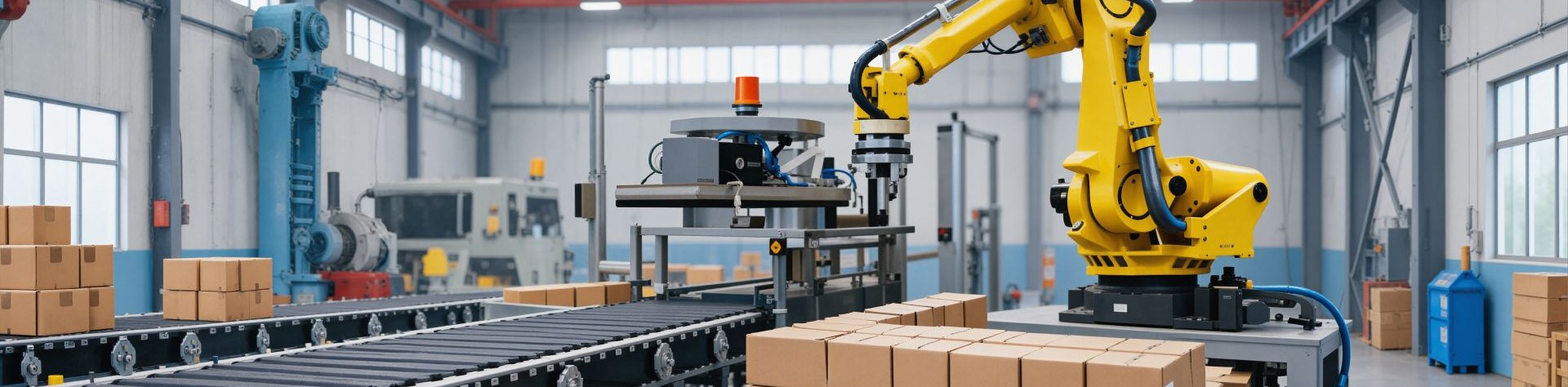
With the global manufacturing sector transitioning towards flexibility and intelligence, collaborative palletizing robots are experiencing unprecedented development opportunities. As a crucial complement to traditional industrial palletizing robots, they are reshaping the automation landscape in logistics and packaging through their advantages of not requiring safety fences, human-robot integration, and flexible deployment.
From the perspective of market drivers, the global labor shortage and continuously rising labor costs are the core engines of industry growth. This is especially true for labor-intensive industries such as food, beverages, pharmaceuticals, and daily chemicals, where it is increasingly difficult to recruit workers for highly repetitive and physically demanding palletizing jobs. Collaborative palletizing robots not only ensure stable 24/7 operation but also significantly reduce the risk of workplace injuries, generally shortening the return on investment (ROI) period to 12-18 months. Furthermore, with the widespread adoption of "high-mix, low-volume" production models, companies have higher demands for production line flexibility. Collaborative palletizing robots can easily adapt through quick changeovers and drag-to-teach programming, making them the top choice for automation upgrades among small and medium-sized enterprises (SMEs).
At the technical level, the integration of AI vision recognition, force control sensing, and mobile bases is driving collaborative palletizing robots towards intelligent perception, autonomous decision-making, and precise execution. Equipped with 3D vision systems, these robots can automatically identify and plan paths for disordered incoming materials. Combined with force control technology, they can handle fragile or irregular packaging without causing damage. Meanwhile, the collaborative application of these robots with AGVs/AMRs is establishing a fully automated closed-loop system across the entire chain of "production line - warehousing - logistics."
Regarding the competitive landscape, domestic and international manufacturers are accelerating their deployments. International brands like ABB and FANUC occupy the high-end market relying on their technological accumulation. In contrast, domestic brands such as JAKA, Estun, and Topstar are leveraging the rising localization rate of core components (with some enterprises achieving over 90% localization of servo systems) to build competitive advantages in cost-effectiveness and localized services.
Looking ahead, as the Industry 5.0 concept deepens, collaborative palletizing robots will be more than just efficiency tools; they will become vital carriers for human-robot collaboration and green manufacturing. Driven by policy support, technological iteration, and market demand, the industry is expected to maintain a compound annual growth rate (CAGR) of over 20% in the next five years, becoming an indispensable part of the intelligent manufacturing ecosystem.
Contact: Mrs. Zhu
Phone: 13770552518
E-mail: zhuchunfeng333@gmail.com
Whatsapp: +8613770552518
Add: Block A, Sansong Renli Building, No. 1 Lixin Road, Jiangbei New Area, Nanjing, Jiangsu Province