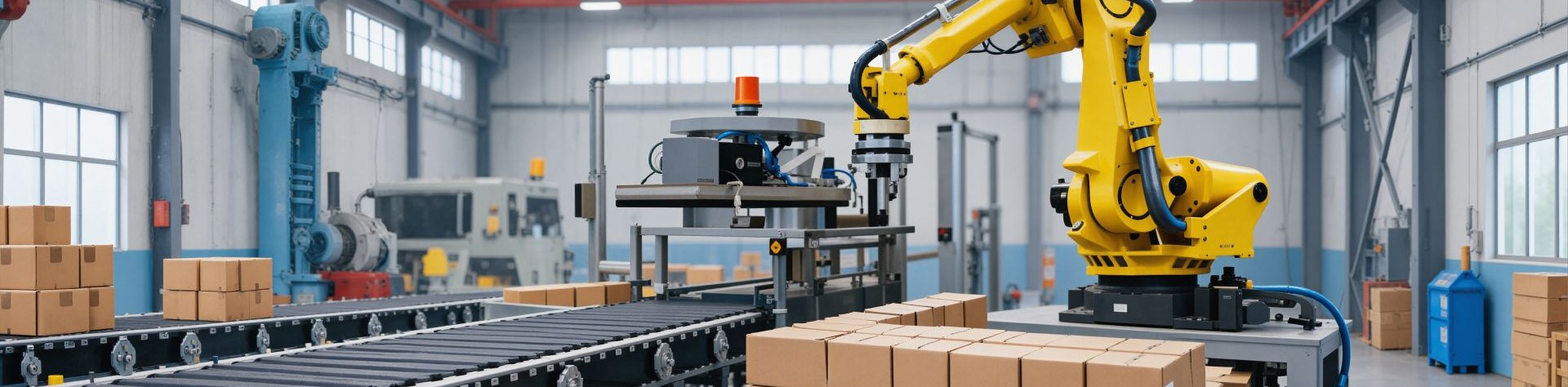
As smart manufacturing continues to advance, palletizing robots have become core equipment for automating production lines across industries such as food and beverage, chemicals, building materials, pharmaceuticals, and logistics. Faced with a wide array of equipment and complex application scenarios, companies often have numerous questions when introducing or optimizing palletizing systems. This article systematically addresses common questions regarding selection evaluation, technical performance, operation and changeovers, maintenance, and return on investment, providing companies with a comprehensive and practical reference for decision-making.
I. Basic Understanding and Selection Evaluation
Palletizing robots are primarily suited for the automated handling and stacking of various regular-shaped materials. Determining whether a factory is ready for this equipment usually depends on whether it faces bottlenecks in production capacity, difficulties in hiring, high risks of occupational injuries, or unstable palletizing patterns. When choosing the right equipment, small four-axis or Cartesian palletizers are highly cost-effective for single-product lines with limited space. However, if frequent product changeovers, handling of complex shapes, or high production flexibility are required, six-axis articulated robots or column-type intelligent palletizers are more appropriate.
II. Technical Parameters and Performance Metrics
Payload capacity is the primary consideration in selection. Companies should calculate this based on the "weight of a single package + weight of the gripper," ideally leaving a 15%-20% safety margin to ensure stability during long-term, high-speed operations. In terms of spatial layout, modern palletizing robots typically require only 2 to 4 square meters of floor space and support various installation methods, including floor-mounted, ceiling-suspended, or rail-guided. However, they require a flat, hardened floor with a load-bearing capacity of no less than 2 tons per square meter. High-efficiency equipment generally operates at a picking frequency of 10-15 cycles per minute, with speeds adjustable to match the pace of upstream packaging lines. For soft packaging like bags, high-end equipment equipped with 3D vision systems and force-sensing technology can automatically correct misalignments, achieving an accurate stacking rate of up to 99.9%.
III. Operation and Flexible Changeovers
New-generation palletizing robots have significantly lowered the barrier to entry. Featuring graphical interfaces and drag-to-teach capabilities, ordinary workers can master them after brief training. To accommodate multi-product, small-batch production, robots equipped with AI vision recognition and recipe storage require no mechanical adjustments; they simply adapt to different material specifications by calling up pre-set programs with a single click. Paired with quick-change gripper systems, production line changeovers can be completed in as little as 10 minutes. Furthermore, existing packaging lines can be easily upgraded to automated systems through on-site surveys and transition section designs by professional system integrators.
IV. Maintenance and Troubleshooting
Thanks to modular joint designs, palletizing robots use significantly fewer core components, achieving a mean time between failures (MTBF) of over 50,000 hours. Daily maintenance costs are low, primarily involving regular lubrication, cleaning sensors, and replacing wearing parts. When common faults occur, they can be quickly diagnosed: for photoelectric sensor failures, check alignment and clean reflector dirt; for abnormal gripper actions, verify air pressure and cylinder seals; for excessive positioning deviations, recalibrate the origin coordinate system and inspect reducer backlash; and for communication interruptions, focus on checking bus wiring and electromagnetic interference sources. With standardized maintenance, the service life of the equipment typically reaches 8 to 10 years.
V. Return on Investment and Procurement Advice
The return on investment (ROI) period for introducing a palletizing robot is usually between 1 and 3 years. For production lines operating at full capacity on a three-shift system, the payback period can be as short as 8 to 12 months. When making a purchasing decision, companies should look beyond simple price comparisons and focus on the supplier's industry-specific customization capabilities, hardware/software quality control, overall system integration, delivery and response times, and localized service levels. For companies with limited budgets or short-term orders, standardized, remanufactured used equipment with a warranty is also a viable alternative, potentially saving 40%-60% in costs.
In conclusion, the selection and application of palletizing robots is a systematic project. Only by comprehensively evaluating their own material characteristics, production capacity plans, and site conditions, and by partnering with technologically sound and service-oriented suppliers, can companies truly transform standardized equipment into reliable productivity and take a steady step forward in their smart manufacturing upgrade.
Contact: Mrs. Zhu
Phone: 13770552518
E-mail: zhuchunfeng333@gmail.com
Whatsapp: +8613770552518
Add: Block A, Sansong Renli Building, No. 1 Lixin Road, Jiangbei New Area, Nanjing, Jiangsu Province